
The job gets done on time. Proving it is done afterwards, from five sources.
KIM 4 Industry is the field operations platform, from the job done in the field to the record that closes it. A bank or a network of branches has fixed assets, ATMs and equipment in dozens or hundreds of locations, each with its own access rules and a response time written into a contract.
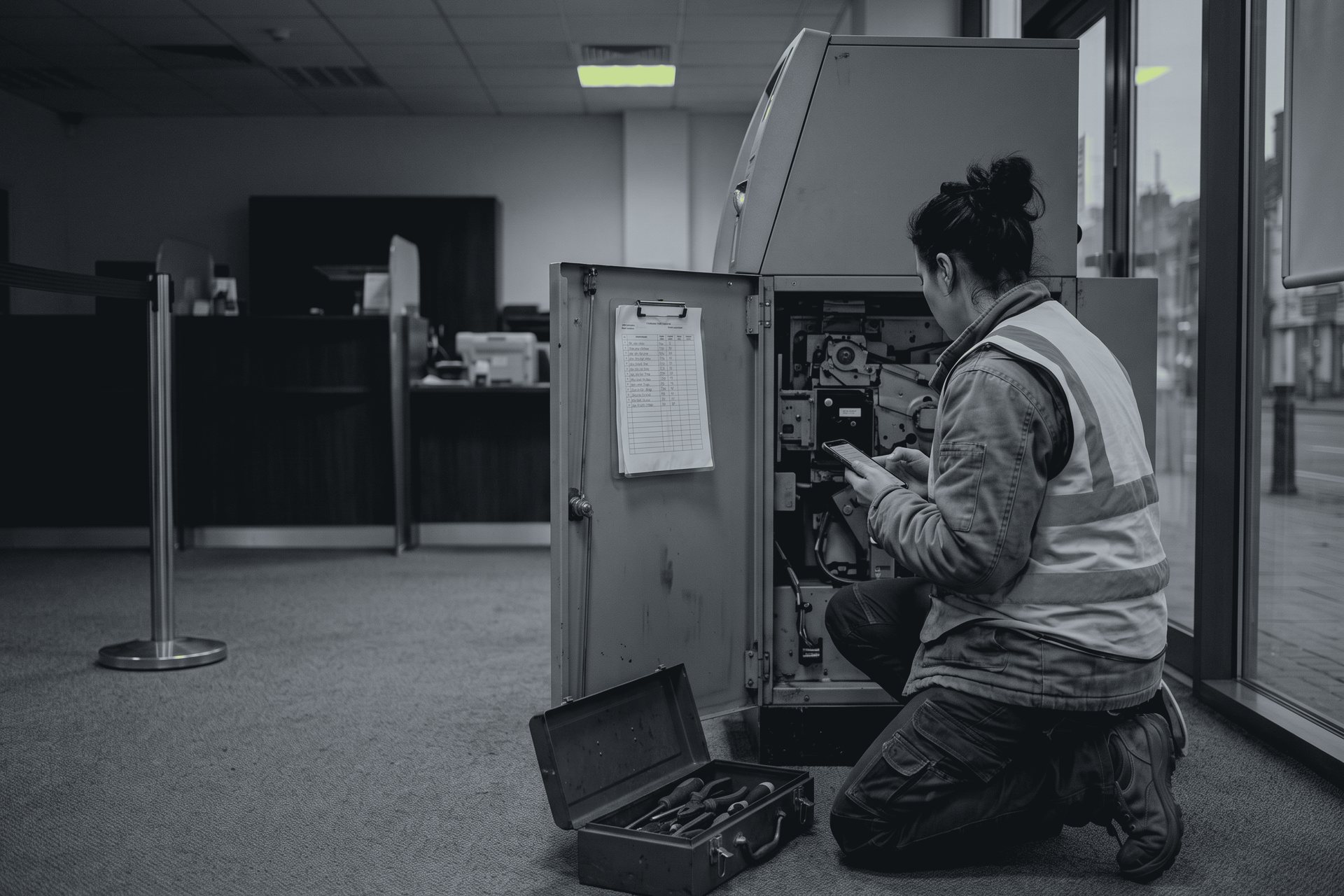
Image built with AI, for illustration.
The evidence is assembled after the fact.
A request is raised, a technician arrives, the equipment is fixed. The contract, however, asks for more than the fix: the time of the call, the time of arrival, the time of closure, the part that went in. Today that evidence is reconstructed from emails, phone logs and paper reports.
The arrival time is recorded in the field, at the moment of arrival.
- 01the branch opens a ticket
- 02the job goes out with its contractual deadline
- 03the technician scans the equipment tag on arrival
- 04the part comes off the service stock with its record
- 05the report for the client comes out of the recorded data, in real time
Equipment with a special access regime gets its own configured workflow.
Image built with AI, for illustration.
Count the reporting.
Two hundred items of equipment, one job each every two months, about a hundred jobs a month. Fifteen minutes of manual reporting per job.
Worked example, KIM 4 Industry, September 2026 · inputs replaced with the client’s own figures“A real-time report on the whole job.”

No client in this sector.
There are no availability figures here, no uptime percentages and no implied implementation. Those are the first claims a buyer in this sector checks.
Verified where failure is not an option.
How many locations, and what does the contract ask you to prove?
We prepare the demo on your equipment and your reporting.