
A closed work order is not a closed operation.
KIM 4 Industry is the field operations platform, from the job done in the field to the record that closes it. Between the work in the field and the record in the office, hours, materials and information get lost, and the cost ends up in the company’s results.
Field operations digitalization is a category, not a module.

Image built with AI, for illustration.
The place, and the chain.
The first axis is where the work happens. Outside the office there is no keyboard, no second monitor and often no signal. A system that assumes any of those gets filled in after the fact, from memory, if it gets filled in at all.
The second axis is how far the operation goes. A job is not finished when it is marked done. Something was consumed, something moved, and a document has to register both.
- Mobile without the chain gives you a better report and the same month-end reconciliation.
- The chain without mobile gives you a complete record that someone still types in, hours later, from notes.
Where each kind of system stops.
Each tool below does its own piece well. The trouble starts where one piece ends and the next begins.
- 01Someone asks for a joba call, a message, a note
- 02Someone does itthe technician, in the field
- 03A part is consumedoff the van or the shelf
- 04An asset is movedbetween locations
- 05The record is writtenand the books finally agree
field service tools · warehouse tools · the module at the desk
The chain has five links. Most tools are built for two of them, and the three that are left over are where the month-end work comes from.
Time first, then certainty.
- Time. The same fact is entered two or three times, by people who were not there.
- Certainty. Nobody can say what a job cost until the month closes, and by then the question has stopped being useful.
- Objects. Tools and assets that exist on a list and nowhere else.
- Answers. When a customer or an auditor asks what was done and with what, the answer is reconstructed instead of retrieved.
Image built with AI, for illustration.
Four conditions, and the order matters.
- Capture at the source. The data enters the system where the work is done, by the person who did it, at the time they did it.
- Offline as a normal state. Not a fallback mode.
- One identity for the object. The same tag read at goods receipt, in the field and at the stock count, so history follows the object and not the spreadsheet.
- The document as an output, not an extra task. The record is generated from what was captured.
“What the report says is what was done.”
So we know that what the report says is what was actually done on the job.
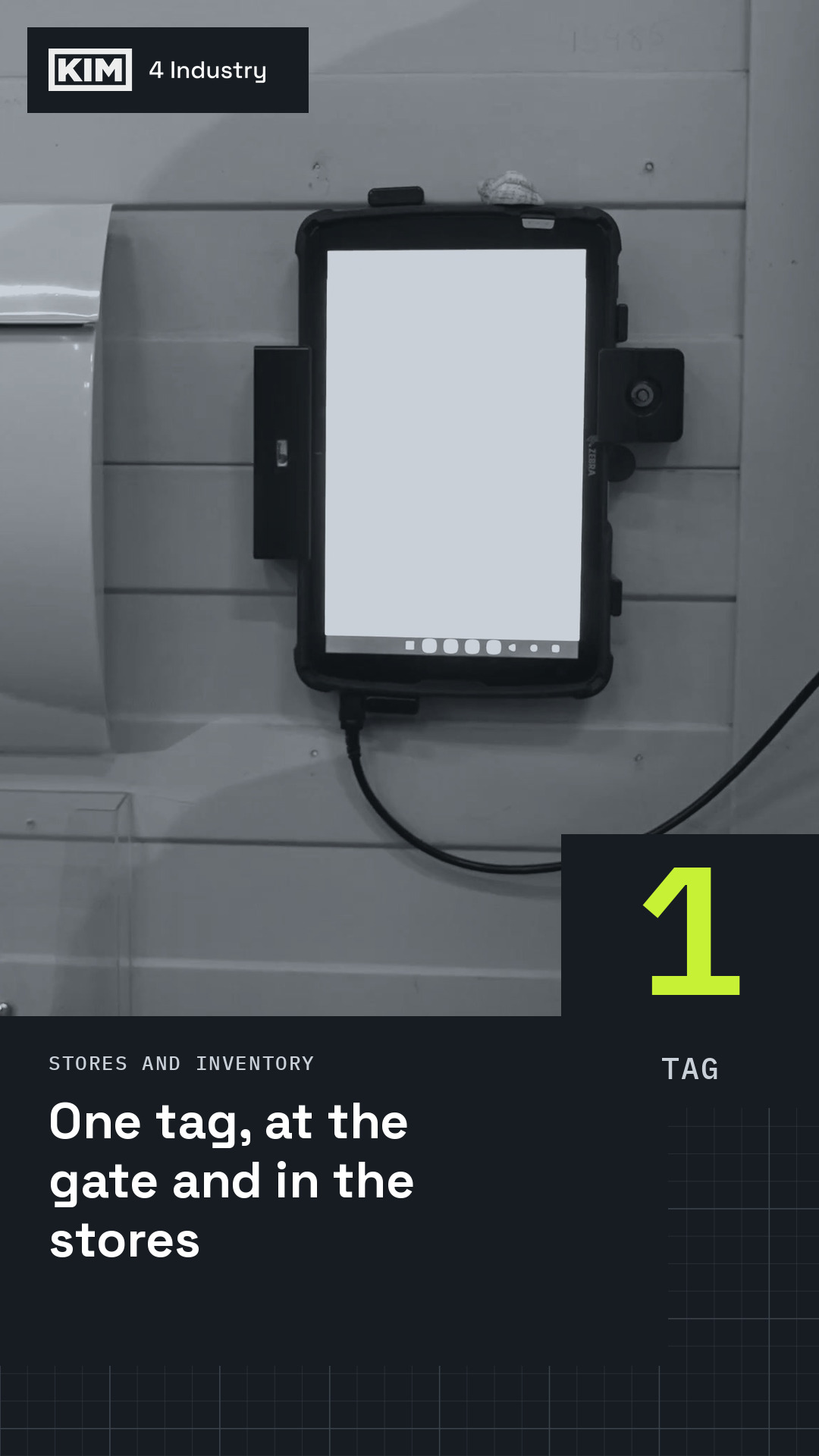
One badge, at the gate and in the stores.
At Kraftanlagen România, people come through the gate and draw material from the stores with the same badge, and information moves from production to approval without passing through paper. Two short pieces filmed at the client show it in about a minute each.

Where the line between them falls.
KIM for Field Services
Everything around the job: the request, the work order, the steps, the photo, the signature, the history of the asset.
Service and maintenance →KIM for Logistics
Everything around the object: goods receipt, issue, movement between locations, stock counts, statutory inspection and calibration records.
Stock and logistics →Information does not stop at the warehouse gate.
Straight answers.
Where does your chain break?
Answer that in a line or two and we will start the demo there, on the part that matches your operation.