
The job report is closed at the machine, when the job is done, at any hour.
KIM 4 Industry is the field operations platform, from the job done in the field to the record that closes it. KIM for Field Services brings the call-out, the work order, the steps carried out, the parts used and the evidence into the system, straight from the technician’s phone.
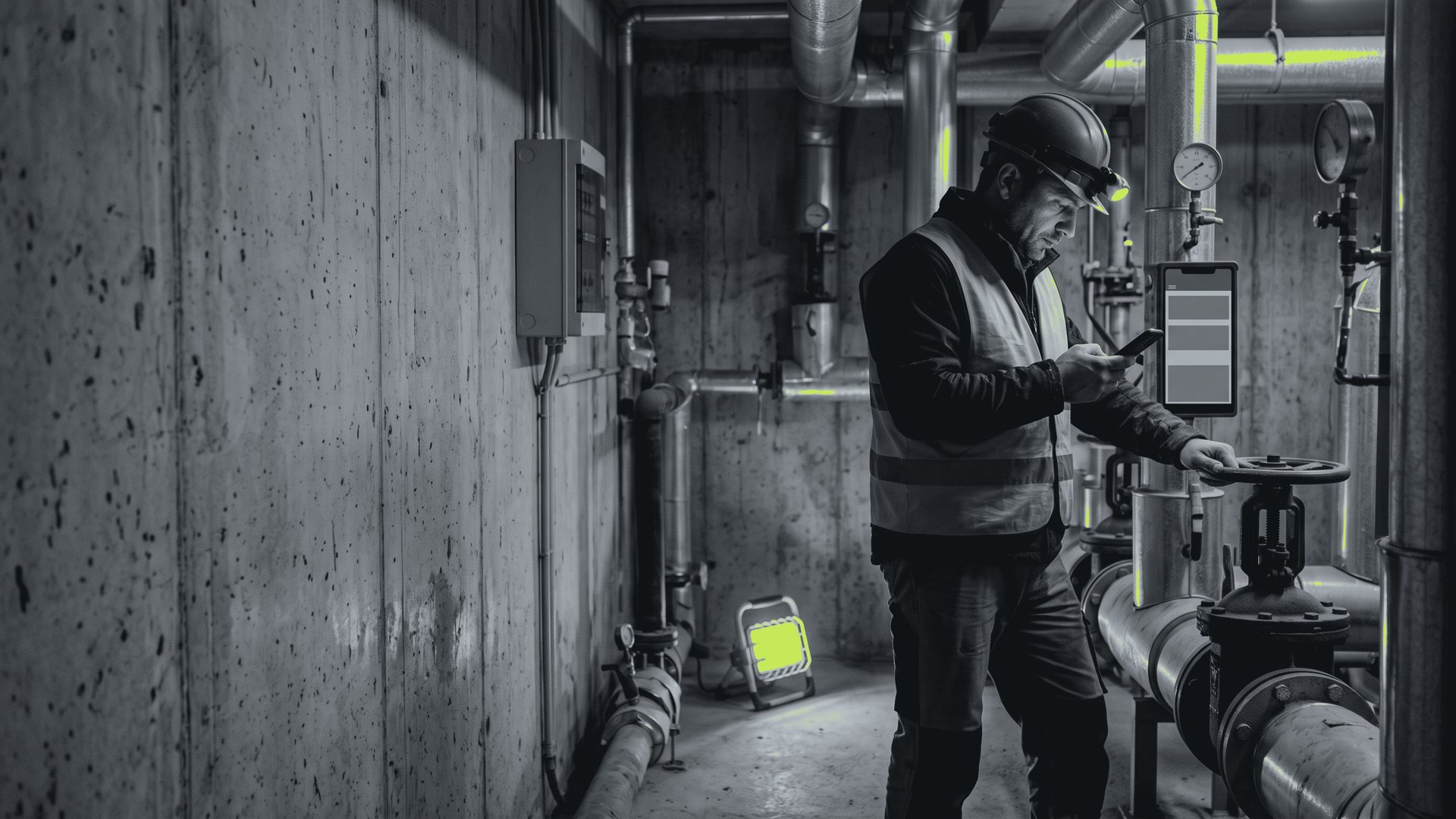
Image built with AI, for illustration.
Four call-outs, one memory.
A technician starts at seven in the morning and finishes the fourth call-out at half past six. Somewhere between the third and the fourth, the plant loses signal. All four reports get written in the evening, at the depot, from what he still remembers.
He remembers the fault. He remembers roughly how long it took. He does not remember which of the two seals he used, or that the customer asked about a second machine on the way out.
What goes missingFive things the evening write-up loses.
- The real time at the machine. Rounded to the half hour, three hours after the fact.
- The part that was used. Taken off the van, booked next week, or never.
- The before and after. Nobody photographs a repair they are about to write up from memory.
- The history of the machine. Held by the technician who was there, not by the company.
- The evidence. When the customer asks what was done and when, the answer is reconstructed.
The technician closes the job on the spot, from the phone.
- 01receives the job
- 02scans the machine and its history opens
- 03photographs what matters
- 04records the part used
- 05confirms and closes
It works without signal. The closing record is generated from exactly what was captured: time, steps, parts, photos, signature. Preventive jobs are raised before the deadline instead of after the breakdown.
Image built with AI, for illustration.
“It’s evening, at the hotel.”
The ERP is very good at managing all of a company’s resources, but most of the time it is accessed from the office, not from the field. We are in the field.
Count the evenings.
A worked example, with the inputs in the open. In the first conversation we replace them with your own figures.
Twelve technicians, four call-outs each, ten minutes of evening write-up per call-out. It does not show up as overtime on a payslip; it comes out of the next job.
Worked example, KIM 4 Industry, September 2026 · inputs replaced with the client’s own figuresThe job is closed. The operation is not.
The seal that went into the machine came off a shelf, and something has to record that it did. That is the other half of the chain, and it is where most systems hand over to a spreadsheet.
A closed work order is not a closed operation.
Straight answers.
Describe a normal day for your technicians.
We will show you that flow prepared for your operation instead of a generic one.